Exoplaneta Helix
A machine, twelve plants and seven lights rehearse the balance of a small world.
Exoplaneta Helix is a kinetic and botanical installation proposed for KNOWCASE Open Call 2027, the shop-window commission run by Sónar+D with Fundación Cotec. It is a proposal, not a finished work: what follows is the idea and the encounter it is designed to produce.
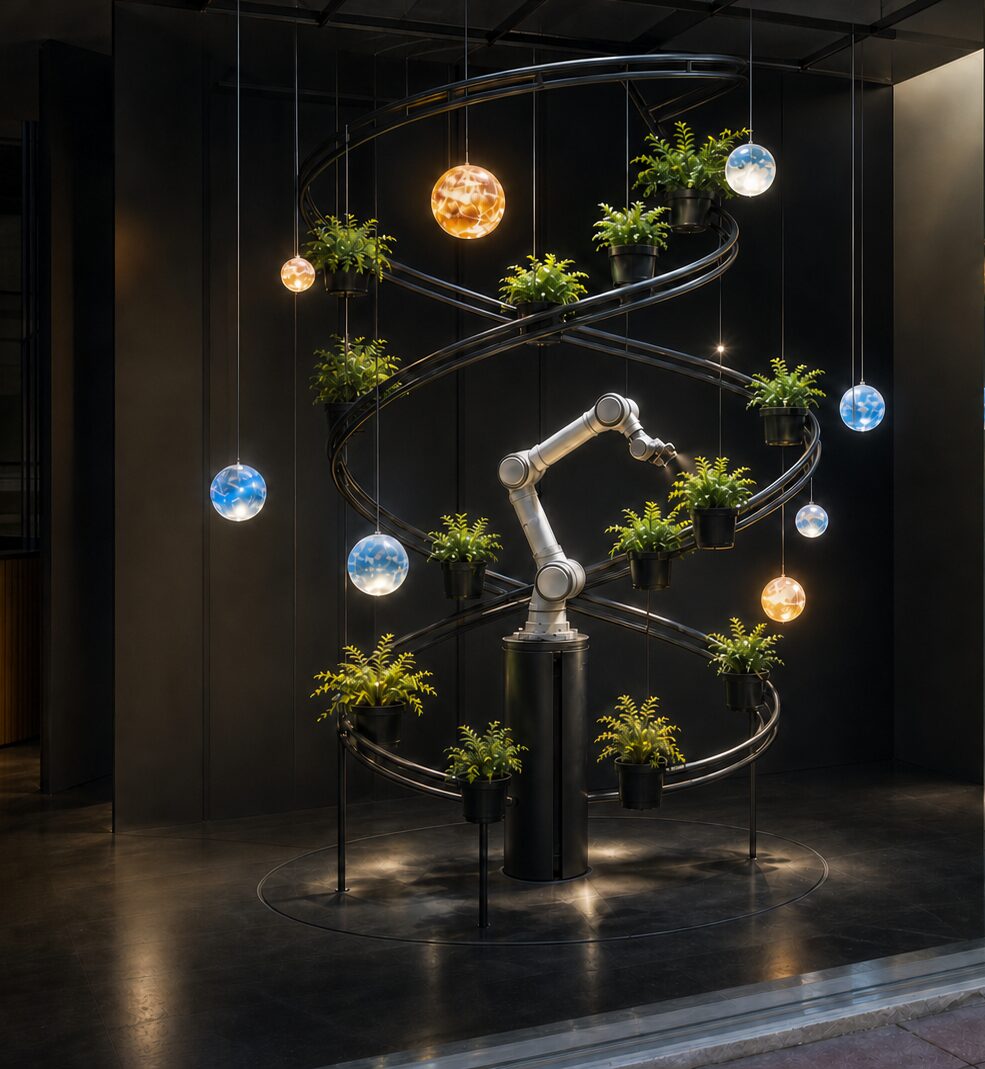
Concept render. Nothing here has been built yet.
A garden kept by a robot
A collaborative robotic arm travels slowly along a helical structure, approaches the plants, and performs gestures of observation and care. At programmed moments it delivers a precise dose of water. Above the helix, seven fixed luminous bodies shift in colour and intensity, following the same temporal score.
The whole system lives inside a glass volume of 3.30 by 2.60 by 1.70 metres, facing the street. There is one moving element and only one: the arm. Everything else — seven planets, twelve plants — holds still and changes at the speed of light or of growth.
Why a machine that only keeps things alive
At a moment when robotics and computation are being steered toward the technologies of war, this machine rehearses the opposite direction. Its single task is to sustain life.
The point is to make that legible from the pavement. Anyone passing can see what an innovation organised around care would actually look like — not as an argument, but as a small world running in front of them. Looking is enough. The phone is optional.
Research questions
- What would a world look like where intelligence, money and innovation were organised around the care of life?
- How is the balance negotiated between biological growth, industrial precision and human maintenance?
- Can a single score organise light, movement and watering inside one cycle?
- How does the perception of a robot change when its main task is to sustain life?
What you see from the street
| State | What the garden does |
|---|---|
| Rest | The arm stays folded; a slow luminous breathing. A minimal, continuous activity. |
| Exploration | The arm travels the helix and approaches different plants. Light links plants and planets in turn. |
| Care | The arm delivers a dose of water to a programmed station. One pitch-light rises and colours the plant being tended. |
| Night | Reduced speed and brightness, movements further apart. Presence without disturbing the street. |
Walking past the glass changes the piece. The helix shifts by parallax, the plants overlap differently, and new relations appear between the arm and the luminous bodies.
One card, one phone, one session
A card held to the glass opens Plantasia Space on your own phone — no installation, no account. Each person plays their own session inside a composition generated from the data of an exoplanet, and simultaneous sessions can be heard mixing in front of the window.
The sound stays in phones and headphones. Nothing is added to the noise of the street.
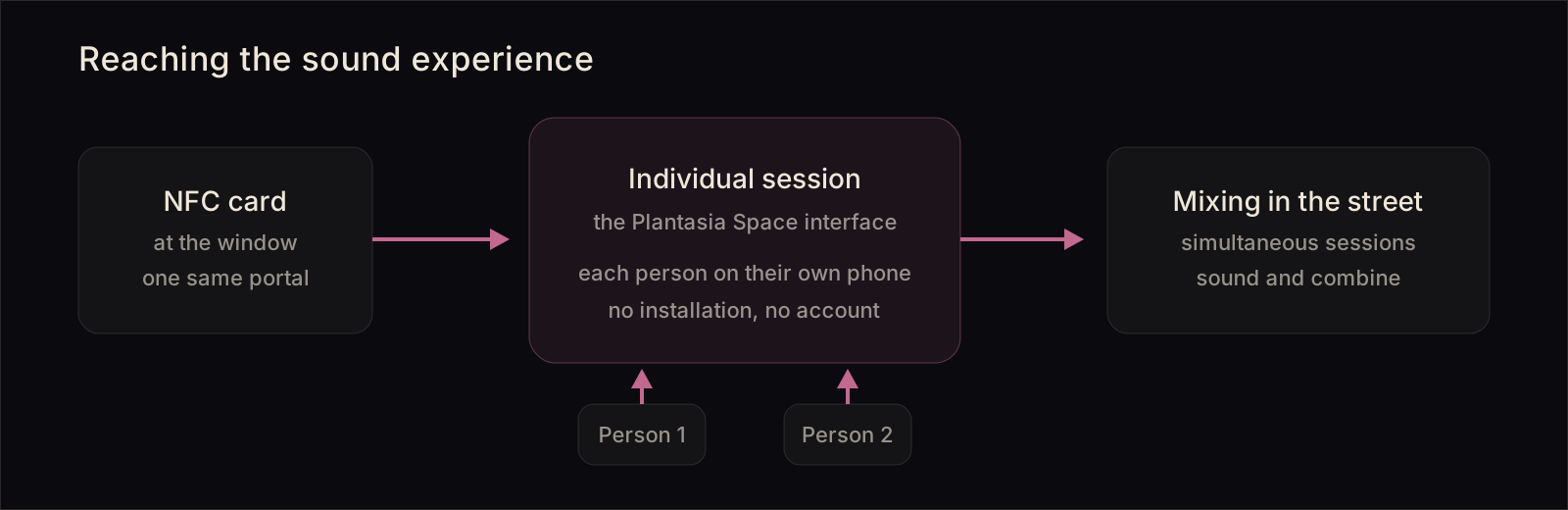
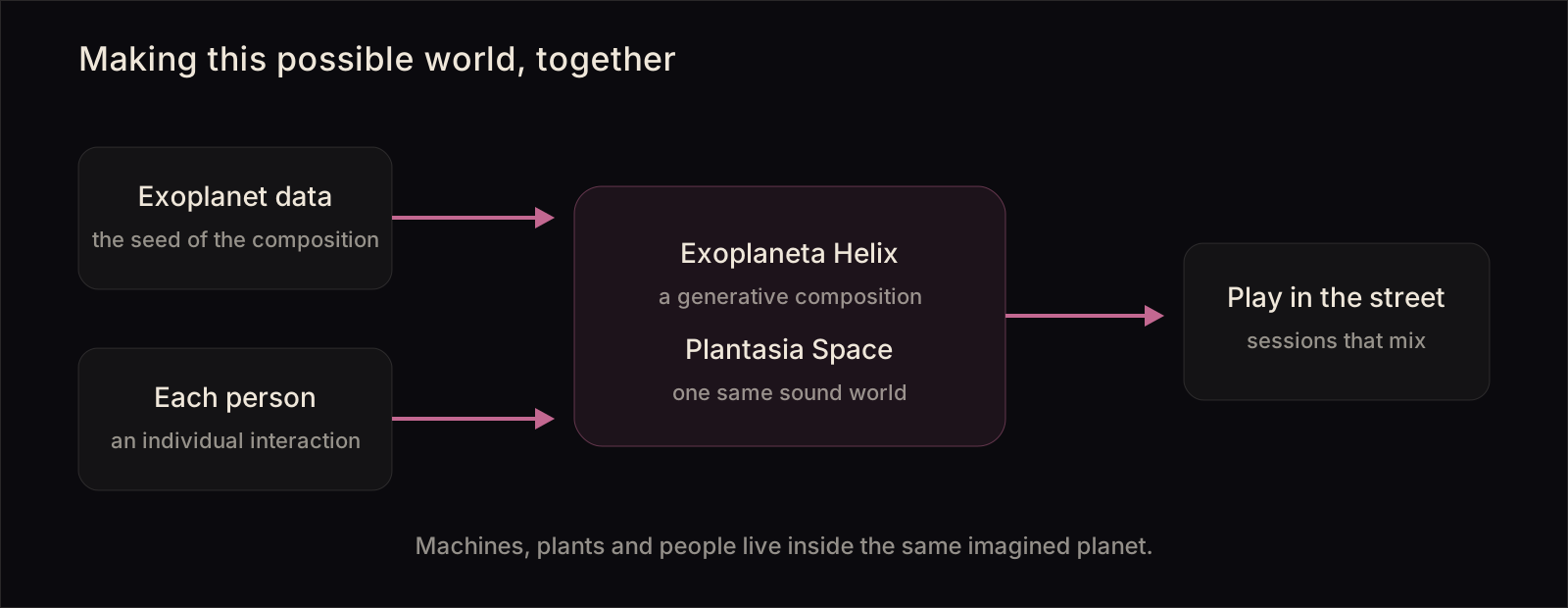
Data from an exoplanet provides the seed; each person’s interaction transforms it. Machine, plants and people compose the same imagined world.
Twelve plants as stations
Spider plant, parlour palm, lady palm, aloe vera, snake plant, corn plant, Madagascar dragon tree, the Janet Craig and Warneckei dracaenas, English ivy, peace lily and pothos.
The set gathers species associated with the NASA Clean Air Study — plants that, under experimental conditions, absorb CO₂ and volatile compounds. Exoplaneta Helix presents them as a living ecosystem, and makes no claim to purify the air of a building. They are stations of colour and duration in a score, and they are also simply twelve plants that have to be kept alive for three years.
Seven lights, twelve months
The seven planets correspond to seven degrees of Heinz Bohlen’s 833 cents scale. The twelve plants contribute colour and duration. Together they are a visible score with no sound in the space.
One note per month guides the choreography: the scale is walked up and back down again to complete a year — 1·2·3·4·5·6·7·6·5·4·3·2. Each month a different degree leads the light, and the interface renews itself. Another ship, another planet. Across the thirty-six months of exhibition, the public sees three complete annual cycles.
Where it comes from
The work gathers three lines of Bruna Guarnieri’s practice: Helix, where twelve plants shared a room with entangled sound worlds; Plantasia Space, which approaches music as world-building; and Entangled Space, a study of regenerative models for music and beyond.
Helix, 2026, is the direct artistic and botanical precedent — an installation where physical cards open portals into entangled sound worlds through a ship-interface called an orbiter, with up to three participants inside a shared listening. It forms part of Are You for Real: Cosmotechnics, Counterfictions, and the Art of Worldbuilding, an international exhibition led by ifa — Institut für Auslandsbeziehungen with the Goethe-Institut, which began its tour of the Americas in Montevideo.
Every gesture of care keeps the possibility of a world open.